
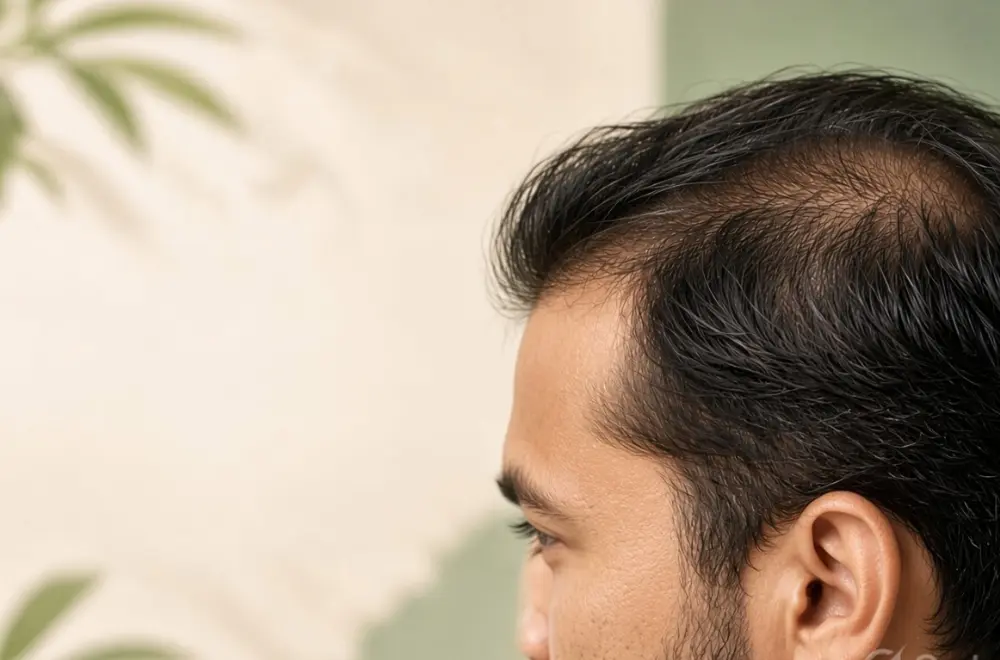
Hair fall rarely starts the day you notice it in the shower drain. It starts quietly, at the root — and your scalp usually tries to tell you first.
A hair strand is only as strong as the root that holds it. When that root weakens — from stress, poor scalp circulation, harsh styling, or nutritional gaps — the strand above it changes long before it actually falls out. The scalp gives warning signs first. Catching them early is the difference between a quick course-correction and months of visible thinning. Below are the five most common early signs, what causes each one, and what actually helps.
1. Excess hair fall while washing or combing
Losing 50–100 strands a day is normal — that’s the natural shedding phase every follicle cycles through. What’s not normal is a sudden jump: clumps in the shower drain, a comb that fills up faster than usual, or a pillow that needs shaking out every morning.
This pattern usually means more hairs than normal have been pushed into the shedding phase at once, often because the root’s grip has loosened. It’s frequently one of the very first signs people notice, simply because it’s the most visible.
What to watch: Count roughly for a week. If shedding stays heavy for more than 2–3 weeks with no obvious trigger like illness or a hair cut, it’s worth addressing at the root, not just the ends.
2.Thinning density and a widening parting
Density loss is sneaky because it happens gradually. A parting that used to sit as a fine line starts looking wider. A ponytail that once needed two wraps of the band now takes three. Photos taken months apart, side by side, often reveal it faster than the mirror does.
This happens when weakened roots produce progressively finer strands each growth cycle — a process called follicle miniaturisation — until the hair covering that patch of scalp is visibly sparser, even before total hair count drops significantly.
What to watch: Take a well-lit photo of your crown and parting every few months. It’s the most reliable way to catch density change early, since day-to-day it’s almost impossible to notice.
3. Dry, brittle strands that snap easily
Healthy roots feed the strand with the moisture and nutrients it needs along its full length. When the root is under-nourished, that supply chain weakens first at the source — so hair often turns dry, rough in texture, and prone to snapping mid-shaft rather than falling out cleanly at the root.
You may notice short broken hairs around the hairline, more static or frizz than usual, or strands that feel like straw rather than silk within days of washing.
What to watch: Breakage looks different from shedding — a shed strand has a small white bulb at the end; a broken one doesn’t. If most of what you’re finding lacks that bulb, the issue is strand strength, not just root grip.
4. Slower regrowth after shedding
Hair naturally regrows after its resting phase, replacing what was shed. When roots are weak, that regrowth phase slows down — so the total volume never quite catches back up. New growth along the hairline may stay wispy and short for longer than it used to, or a trim seems to “disappear” faster than before.
This is a subtler sign because nothing looks dramatically wrong day to day — it’s the pace of recovery, not the shedding itself, that has changed.
5. An itchy, flaky, or oily scalp
Roots don’t live in isolation — they sit in scalp skin, and scalp skin has to stay balanced for a root to stay anchored well. Persistent itching, flaking, tightness, or scalp that turns oily again within a day of washing all point to a scalp environment under strain, which weakens the follicle’s hold over time.
This sign often gets dismissed as “just dandruff,” but an irritated scalp and a struggling root usually arrive together, not as separate problems.
Why root strength matters more than any single symptom
Each sign above can look minor in isolation — a bit more shedding this week, slightly drier ends. But roots weaken gradually, and by the time hair loss is obvious in the mirror, that follicle has often been under strain for months. Treating the root environment early — circulation, nourishment, and gentle handling — is far easier than trying to reverse visible thinning later. The goal isn’t to panic at the first extra strand on your brush; it’s to notice the pattern and respond while the root still has room to recover.
Simple habits that support stronger roots
None of these are quick fixes — roots respond to consistency, not a single treatment. But done regularly, they address most of the causes behind the five signs above.
- Scalp massage, a few minutes daily — improves blood flow to follicles, helping deliver nutrients to the root.
- Gentle handling when wet — hair is weakest right after washing; a wide-tooth comb reduces needless breakage.
- Protein & iron in your diet — follicles are metabolically active and need consistent fuel to build strong strands.
- A calm, clean scalp — regular, gentle cleansing keeps buildup from suffocating the follicle opening.
- Nourishing oil, massaged in — warm oil before washing softens the scalp and feeds the root directly.
- Lower heat, fewer tight styles — constant tension and high heat stress the follicle where it anchors the strand.